Words, Wildlife, Rock & Roll
Borneo, Wales, Infinity and Beyond...

Words, Wildlife, Rock & Roll <br> Borneo, Wales, Infinity and Beyond...

Saturday, 3 July 2010

Glastonbury Festival

Before I get going again I should apologise for the lack of posts in the last couple of weeks; I've been busy moving partying/enjoying the sunshine/moving house etc. Now that I'm residing in sleepy Dorset again I'll have more time to blog for any loyal followers who are still checking back every now and again!

My first Glastonbury Festival experience more than lived up to my expectations. The Green Fields, in particular, were fantastic. Pedalling to contribute to powering amp equipment, perusing the Greenpeace field and learning about their current campaigns, painting a paper-mache jigsaw-puzzle ball as part of a community art piece and watching stone-masons at work were enough reason alone to step away from the main stages for a while.

However, in terms of music, these were my top 5 Glastonbury Festival highlights:

FIVE: Scissor Sister Sunset

Watching the sun go down behind the Pyramid Stage on Saturday evening, whilst the Scissor Sisters were joined onstage by Kylie Minogue will remain with me for a long time...


FOUR: Tie My Very British Kangaroo Down, Old Chap
This is the only video I could find online of this version of the Rolf classic. Rolf Harris gave one of the best performances I saw all weekend, and yes, I did see some of the other acts! Skip forward to 4 minutes 35 seconds-ish to hear what I'm talking about... mad!

THREE: The Chain

Once again, I'm afraid you'll have to skip over the first song (which I believe has made it onto the Twilight soundtrack, if you're interested in vampires at all) and you will find the finest cover of The Chain you're ever likely to hear. And I thought I liked Fleetwood Mac...

TWO: The King Blues

Militant ska: It should be a new genre. At any rate, it describes this band quite well, and if you get the chance to check out their music (the album, 'Under the Fog' is a good start) then do! The Leftfield tent was completely packed at half past seven on the Sunday evening, and it was definitely worth missing Faithless and MGMT on the main stages.

ONE: The Edge

For those of us who love U2 and were more than a little disappointed when they had to pull out of Glastonbury, and who were already quite excited to be watching Muse headline the Saturday evening, and who were exhausted after spending eight hours that day checking wristbands on the gates, to watch the lights go down for the encore and hear the opening notes of 'Where The Streets Have No Name' in a distinctly 'The Edge' style could not possibly have been more perfect, even if Bono was there (but I didn't say that).

Thursday, 3 June 2010

03 June 2010

World Environment Day is approaching. Events will take place across the world on June 5 to promote environmental awareness and to pressure political bodies to take action on important issues.

2010 has been declared the International Year of Biodiversity by the United Nations. Biodiversity is not only important for preserving individual species and habitats, but is also essential for maintaining the ecosystem services we rely on, such as food, clean water and fuel.

The UK has a Biodiversity Action Plan to monitor and protect our biodiversity. The latest figures from it estimate that over a third of the high priority species in Wales are declining or have been lost since the last assessment.

Economically, biodiversity loss is also a bit of a nightmare. ‘The Economics of Ecosystems and Biodiversity Study’ could well be the most influential report since ‘The Economics of Climate Change’ by Lord Stern in 2007.

The study was undertaken by leading economist and senior banker, Pavan Sukhdev, and the resulting report is expected to announce that the ratio of costs of conserving natural ecosystems to the benefits of doing so range from one to ten, up to as much as one to 100.

Natural ecosystems play an essential role in supporting human civilisation, but we’re currently living in the age of the sixth mass extinction. The last time Earth experienced one of these was roughly 65 million years ago, when a meteorite collided with the Yucatan Peninsula and led to the extinction of the dinosaurs.

However, this mass extinction is due to the destruction of numerous habitats faster than species can adapt to suit them. If they can’t adapt to altered habitats, the only other viable option is to move, but the corridors that once made this possible are now largely absent or blocked. The remaining path to take is extinction.

The silver lining is that, because this mass extinction is largely caused by us, it is not an unpredictable event that we can do nothing about. Reversing the biodiversity crisis is one of the biggest and most complex challenges to face our generation, and it will take global participation and skills from all walks of life to solve.

World Environment Day has been celebrated on June 5 since 1972. In Cardiff, the National Museum of Wales is holding an ECOfair on the day to celebrate it, which includes an informal Q&A session at 2pm. The theme this year is ‘many species, one planet, one future’. It may be clichéd but it’s all we’ve got.

- as published in the latest issue of gair rhydd, Cardiff's student newspaper

Saturday, 22 May 2010

22 MAY 2010

Final exams have eaten so much of the last month that I haven't actually checked the news or left the house/garden for so long that I have nothing of environmental interest to comment on! The only thing I'm aware of that's happening outside the exam bubble is Bono's back surgery, which is not only a bit of a nuisance for poor Bono but also puts U2's Glastonbury Festival appearance in jeopardy. However, I'd rather he took the time to get better than rush it and appear at Glasto. Even if it is the light at the end of the tunnel that's seen me through the last few weeks!

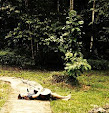
Anyway, I came across this photo from a trip to Lok Kawi Zoo in Kota Kinabalu, August 2008, but it sums up how I'm feeling right now (minus the ice-cream).

Tuesday, 11 May 2010

Revision of Local Conservation Politics

It's exam time; we're all starting to crack.

The following is the product of the last hour's revision session concerning the development of UK conservation legislation:

Local Politics and Conservation

In 1949 was the Nature Conservancy
The 1960s saw eco-popularity,
In ‘65 it joined the NERC
And split again in ‘73.
Research in the NCC
Is now CEH, which was ITE.

In ‘81 we had the W & C Act,
Opposed by NFU: True Fact.
In’ 89 it all went statutory
With the breaking down of the JNCC.
A ’92 summit was quite big in Rio,
BAPS in ’94 were backed by 2000’s CROW.

Natura 2000 and the Habitats Directive,
Ramsar Wetlands, quite effective.
NERC ’06 said each public body
Must be nice to the environment (like Bill Oddie).
NNRS and triple-Sis
Keep our country fairly nice.

Now, if only I can memorise that for the exam tomorrow...

Wednesday, 5 May 2010

A Green Government? I wish.

If you're reading this in the UK, I apologise for jumping on the bandwagon. If you're far away from the red, yellow and blue campaigns then think yourself lucky, it's given me quite a headache! At 7am tomorrow my alarm clock will go off and the polling stations will open. David Cameron can finally take a break from his slightly over-the-top continuous 36 hours (and counting) final campaign, Nick Clegg can, perhaps, give his face a rest from smiling non-stop for four and a half weeks and Gordon Brown might get a chance to visit an estate agent to suss out his potential new pad.

We don't really know who's going to be having dinner at Number 10 on Friday evening, but with less than 24 hours to go until the close of polls, I thought I'd have one last look at an important area of policy that's been almost completely overlooked under the big black clouds of the recession and volcanic ash...

...The Environment

The Conservatives start by saying that they will "make Britain greener by tackling climate change and protecting and enhancing our environment", which is interesting because the Liberal Democrats are telling me that "The Liberal Democrats are the only party in British politics that can and will put the environment at the heart of government" and Labour state that "the green agenda is fundamentally rooted in Labour values". This will be interesting; I naively thought it would be simple to get to the bottom of who has the best policies, but it looks like I'll need to be a bit more Sherlock Holmes.

As the recycling hasn't been collected in Cathays for the last fortnight I'll take a look at waste management. The Conservatives pledge to work towards a 'zero waste Britain' and promote recycling. Of course, recylcling reduces the amount of junk going to landfill, but in order to recycle, we need energy, but we'll come to that in a moment. Labour's website doesn't seem to mention waste other than in its opening blurb that states "By taking the action we need to tackle climate change and reduce waste we can drive economic growth", but maybe they'll redeem themselves in other ways. The Liberal Democrats are also pushing the 'zero waste Britain' approach and pledge to increase anaerobic digestion technology to generate energy from food and farm waste.

The Liberal Democrats also pledge to meet the EU 15% renewable energy target, no small task, would set a target for 40% of UK electricity to come from 'clean' sources, and would aim to improve energy efficiency in the public and commercial sectors by 30%, by 2020. All new coal-powered station plans would be halted unless they incorporated the best carbon capture and storage (CCS) technology. They're not big fans of nuclear energy and would focus on renewables as a cheaper, more sustainable solution to the energy crisis. Conservatives, on the other hand, would create four CCS power plants, set legal limits on power station emissions, deliver a 10% carbon emissions cut from government activities within the first year, create an off-shore energy grid and encourage small-scale energy generation. I assume this means of the renewable variety rather than back-yard coal plants, but it isn't clarified in the literature. I hold Labour under rather more scrutiny in this area, as with 13 years in power we haven't yet seen the leaps and bounds promised to us, but maybe it's worth another shot, so I'll hear them out. They intend to stick to the 2008 Climate Change Act which requires greenhouse gas emissions to drop by 34% by 2020. They support 'clean coal' (*cough*) and nuclear power, and would like 15% of our energy to come from renewable sources by 2020.

In terms of protecting our biodiversity, I feel we're faced with an inadequate set of policies. Our current government mention it once: "Labour believes that the beauty and biodiversity of Britain’s countryside and green spaces enrich the quality of our lives", but then fails to mention how it intends to preserve it. It gets Brownie Points for introducing the Countryside and Rights of Way Act (2000) which gave statutory backing to Biodiversity Action Plans, but it would be nice to know what, if anything, it intends to do next. It proposes to extend green belts and for 60% of development to be on brownfield land, but I wonder where they want to put the other 40%.

In their section regarding biodiversity, the Conservatives state that they want to reduce litter. It seems like this is probably more our responsibility than theirs, but I can't complain about good intentions. Perhaps they can wash my dishes whilst they're at it. They also want to plant one million trees during their potential term in office; as long as they're British natives I'm all for it (don't worry, I'm not going all British National Party, I'm only worried about invasive species). The Liberal Democrats worry me slightly in their use of the word 'could': "We will introduce landscape-scale policies, with measurable objectives which could include things like the promotion of biodiversity", however they do pledge to include gardens as greenfield sites in planning law, so that they aren't so easily built over by 'garden grabbers'. As our gardens support such a large amount of Britain's wildlife, this is particularly important.

I could go on all night, but by the time I'd finish the polls would be closed. For further information, check out the following (in alphabetical order!):
Conservatives
Labour
Liberal Democrats

Of course, there are other important issues to base your voting decision on, but hopefully I've laid out a few of the major 'green' topics of interest.

I'm still undecided...

Sunday, 25 April 2010

The End of Tiger Blogfest, but Not the End of the Tiger

It's the end of the Tiger Blog Fest 2010, but if you're not quite sure why I'm going on about tigers, it's entirely my fault, so let me explain.

Since the onset of the Chinese New Year celebrations, we've been living in the year of the tiger. Numbers at tiger social gatherngs are dwindling, but it's not that they're not cool, or that nobody likes them; far from it. It's more that, as is sadly often the case, we've threatened their existence by removing their habitat and taking them from the wild for entertainment, 'medicinal' purposes and such specialities as 'tiger-bone wine'. To save you the trouble of googling it, tiger-bone wine is a drink made from the carcus of a tiger soaked in red wine. Seriously, a bottle of Blossom Hill from the corner shop does the trick, believe me.

That said, there's no point in being gloomy about these things, especially if you're a tiger, 'Carpe diem' and all that, so let's focus on the opportunities to give these beasts a helping hand. The WWF et al. have launched TX2, a campaign to double the number of Malayan tigers by the year 2020. Ambitious? Yes. Impossible? No. It would bring the numbers up to 1,000 individuals and ensure a bit of stability for a species teetering on the brink of uncertainty.

Positive thinking goes a long way, and the power of public support for a cause should never be underestimated. Get talking about tigers or get involved if you want to, just don't get complacent, because there's still a long way to go.


Friday, 23 April 2010

Tigers in Society...

You don't see many tigers in Cardiff. Or in Bournemouth. Or anywhere else in the UK really, but whilst pondering what to write about tigers it struck me that they're pretty much everywhere:

At the pub...


...at breakfast...


...and in the news...


...and they'll probably be lurking in those areas for some time to come. Make sure they continue to grace forests too. Check out this website for further information.