A recent census of mountain gorillas in the Virunga national parks, has indicated that population numbers are on the increase.
The three Virunga national parks in Rwanda, Uganda and the Democratic Republic of Congo cover 450 square kilometres of potential gorilla habitat. The recent studies suggest that the population is growing at a rate of 3.7% each year, which is fantastic news for the (truly) great apes! It even comes close to deserving the Guardian's optimistic headline: Mountain Gorilla Numbers Soar. To some this may seem like a slight exaggeration, at an increase of 100 individuals since 2003, but it's not bad going for an animal with such slow reproductive habits, subject to disease outbreaks with disastrous consequences and living in such a fragile habitat.
The favoured explanation for the increase seems to be improvements in protecting the gorillas from disease outbreaks, for example by reducing contact time with humans, and by cracking down on poaching for trade in body parts.
This happy news comes just in time for Christmas, but it's important not to get complacent; there's a long way to go for the mountain gorilla.
Words, Wildlife, Rock & Roll
Borneo, Wales, Infinity and Beyond...

Thursday, 9 December 2010
Good for Gorillas


 I created this blog to document my year living in the jungle in Kinabatangan, Sabah.
I work in animal care at a rescue centre and as a freelance writer.
Follow me on Twitter @Rachelhenson
Monday, 27 September 2010
A Small Joke...
Two zoo keepers are chatting over a coffee.
The gibbon keeper says: "So how come you don't want to work with gibbons then? They're awesome."
The orangutan keeper replies: "They're alright, but they're not great apes..."
Get it? Great Apes... Made it up all by myself. Okay, so maybe my comedy career is limited. But maybe I could get a crowd of primatologists? Ones with no sense of humour? No? Okay, I'll stick to the day job then.
I created this blog to document my year living in the jungle in Kinabatangan, Sabah.
I work in animal care at a rescue centre and as a freelance writer.
Follow me on Twitter @Rachelhenson
Thursday, 16 September 2010
Very Large Orangutan
A very large orangutan has come to live in Dorset. Oshine has moved from South Africa to reside at Monkey World Ape Rescue Centre to live with other orangutans at the sanctuary. Oshine is 12 years old and is thought to weigh 100 kg, which is much heavier than an average female orangutan which would weigh in at around 40-45 kg. She appears to be settling in slowly but well, getting used to the big changes in lifestyle that come with the transition between being someone's pet and joining the orangutan nursery at the rescue centre.
Good luck Oshine...
To see the BBC coverage, follow this link
Good luck Oshine...
To see the BBC coverage, follow this link
I created this blog to document my year living in the jungle in Kinabatangan, Sabah.
I work in animal care at a rescue centre and as a freelance writer.
Follow me on Twitter @Rachelhenson
Saturday, 3 July 2010
Glastonbury Festival
Before I get going again I should apologise for the lack of posts in the last couple of weeks; I've been busy moving partying/enjoying the sunshine/moving house etc. Now that I'm residing in sleepy Dorset again I'll have more time to blog for any loyal followers who are still checking back every now and again!
My first Glastonbury Festival experience more than lived up to my expectations. The Green Fields, in particular, were fantastic. Pedalling to contribute to powering amp equipment, perusing the Greenpeace field and learning about their current campaigns, painting a paper-mache jigsaw-puzzle ball as part of a community art piece and watching stone-masons at work were enough reason alone to step away from the main stages for a while.
However, in terms of music, these were my top 5 Glastonbury Festival highlights:
FIVE: Scissor Sister Sunset
 Watching the sun go down behind the Pyramid Stage on Saturday evening, whilst the Scissor Sisters were joined onstage by Kylie Minogue will remain with me for a long time...
FOUR: Tie My Very British Kangaroo Down, Old Chap
This is the only video I could find online of this version of the Rolf classic. Rolf Harris gave one of the best performances I saw all weekend, and yes, I did see some of the other acts! Skip forward to 4 minutes 35 seconds-ish to hear what I'm talking about... mad!
THREE: The Chain
Once again, I'm afraid you'll have to skip over the first song (which I believe has made it onto the Twilight soundtrack, if you're interested in vampires at all) and you will find the finest cover of The Chain you're ever likely to hear. And I thought I liked Fleetwood Mac...
TWO: The King Blues

Militant ska: It should be a new genre. At any rate, it describes this band quite well, and if you get the chance to check out their music (the album, 'Under the Fog' is a good start) then do! The Leftfield tent was completely packed at half past seven on the Sunday evening, and it was definitely worth missing Faithless and MGMT on the main stages.
ONE: The Edge
For those of us who love U2 and were more than a little disappointed when they had to pull out of Glastonbury, and who were already quite excited to be watching Muse headline the Saturday evening, and who were exhausted after spending eight hours that day checking wristbands on the gates, to watch the lights go down for the encore and hear the opening notes of 'Where The Streets Have No Name' in a distinctly 'The Edge' style could not possibly have been more perfect, even if Bono was there (but I didn't say that).
I created this blog to document my year living in the jungle in Kinabatangan, Sabah.
I work in animal care at a rescue centre and as a freelance writer.
Follow me on Twitter @Rachelhenson
Thursday, 3 June 2010
03 June 2010
World Environment Day is approaching. Events will take place across the world on June 5 to promote environmental awareness and to pressure political bodies to take action on important issues.
2010 has been declared the International Year of Biodiversity by the United Nations. Biodiversity is not only important for preserving individual species and habitats, but is also essential for maintaining the ecosystem services we rely on, such as food, clean water and fuel.
The UK has a Biodiversity Action Plan to monitor and protect our biodiversity. The latest figures from it estimate that over a third of the high priority species in Wales are declining or have been lost since the last assessment.
Economically, biodiversity loss is also a bit of a nightmare. ‘The Economics of Ecosystems and Biodiversity Study’ could well be the most influential report since ‘The Economics of Climate Change’ by Lord Stern in 2007.
The study was undertaken by leading economist and senior banker, Pavan Sukhdev, and the resulting report is expected to announce that the ratio of costs of conserving natural ecosystems to the benefits of doing so range from one to ten, up to as much as one to 100.
Natural ecosystems play an essential role in supporting human civilisation, but we’re currently living in the age of the sixth mass extinction. The last time Earth experienced one of these was roughly 65 million years ago, when a meteorite collided with the Yucatan Peninsula and led to the extinction of the dinosaurs.
However, this mass extinction is due to the destruction of numerous habitats faster than species can adapt to suit them. If they can’t adapt to altered habitats, the only other viable option is to move, but the corridors that once made this possible are now largely absent or blocked. The remaining path to take is extinction.
The silver lining is that, because this mass extinction is largely caused by us, it is not an unpredictable event that we can do nothing about. Reversing the biodiversity crisis is one of the biggest and most complex challenges to face our generation, and it will take global participation and skills from all walks of life to solve.
World Environment Day has been celebrated on June 5 since 1972. In Cardiff, the National Museum of Wales is holding an ECOfair on the day to celebrate it, which includes an informal Q&A session at 2pm. The theme this year is ‘many species, one planet, one future’. It may be clichéd but it’s all we’ve got.
- as published in the latest issue of gair rhydd, Cardiff's student newspaper
I created this blog to document my year living in the jungle in Kinabatangan, Sabah.
I work in animal care at a rescue centre and as a freelance writer.
Follow me on Twitter @Rachelhenson
Saturday, 22 May 2010
22 MAY 2010
Final exams have eaten so much of the last month that I haven't actually checked the news or left the house/garden for so long that I have nothing of environmental interest to comment on! The only thing I'm aware of that's happening outside the exam bubble is Bono's back surgery, which is not only a bit of a nuisance for poor Bono but also puts U2's Glastonbury Festival appearance in jeopardy. However, I'd rather he took the time to get better than rush it and appear at Glasto. Even if it is the light at the end of the tunnel that's seen me through the last few weeks!
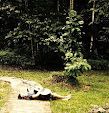
Anyway, I came across this photo from a trip to Lok Kawi Zoo in Kota Kinabalu, August 2008, but it sums up how I'm feeling right now (minus the ice-cream).

Anyway, I came across this photo from a trip to Lok Kawi Zoo in Kota Kinabalu, August 2008, but it sums up how I'm feeling right now (minus the ice-cream).
 I created this blog to document my year living in the jungle in Kinabatangan, Sabah.
I work in animal care at a rescue centre and as a freelance writer.
Follow me on Twitter @Rachelhenson
Tuesday, 11 May 2010
Revision of Local Conservation Politics
It's exam time; we're all starting to crack.
The following is the product of the last hour's revision session concerning the development of UK conservation legislation:
Local Politics and Conservation
In 1949 was the Nature Conservancy
The 1960s saw eco-popularity,
In ‘65 it joined the NERC
And split again in ‘73.
Research in the NCC
Is now CEH, which was ITE.
In ‘81 we had the W & C Act,
Opposed by NFU: True Fact.
In’ 89 it all went statutory
With the breaking down of the JNCC.
A ’92 summit was quite big in Rio,
BAPS in ’94 were backed by 2000’s CROW.
Natura 2000 and the Habitats Directive,
Ramsar Wetlands, quite effective.
NERC ’06 said each public body
Must be nice to the environment (like Bill Oddie).
NNRS and triple-Sis
Keep our country fairly nice.
Now, if only I can memorise that for the exam tomorrow...
I created this blog to document my year living in the jungle in Kinabatangan, Sabah.
I work in animal care at a rescue centre and as a freelance writer.
Follow me on Twitter @Rachelhenson
Subscribe to:
Posts (Atom)